




Have you ever wondered what life was like in the age of Lord Krishna?
The Dwapara Yugam was a time when light and darkness coexisted, when dharma (righteousness) still guided humanity but was slowly fading under the weight of ego and material desire. Yet, even in such times, divine compassion shone through — in the form of Lord Krishna, the eighth incarnation of Lord Vishnu.
In this article, we explore the Dwapara Yugam story in English, its divine lessons, and its deep connection to Diwali — the festival celebrating the victory of light over ignorance.
The Beginning of Dwapara Yugam
After the righteous Tretha Yuga, where Lord Rama reigned, the Dwapara Yugam began. In this age, dharma declined to half its strength. Humanity became divided between truth and deceit, faith and doubt. Kings ruled with pride, and people’s devotion weakened.
However, even as virtue waned, the Lord promised in the Bhagavad Gita:
“Whenever there is decline of righteousness and rise of unrighteousness, I manifest Myself.”
Thus, Lord Vishnu took birth as Sri Krishna, the Supreme Being who guided the world through wisdom, playfulness, and love.
The Birth of Lord Krishna – The Light Amidst Darkness
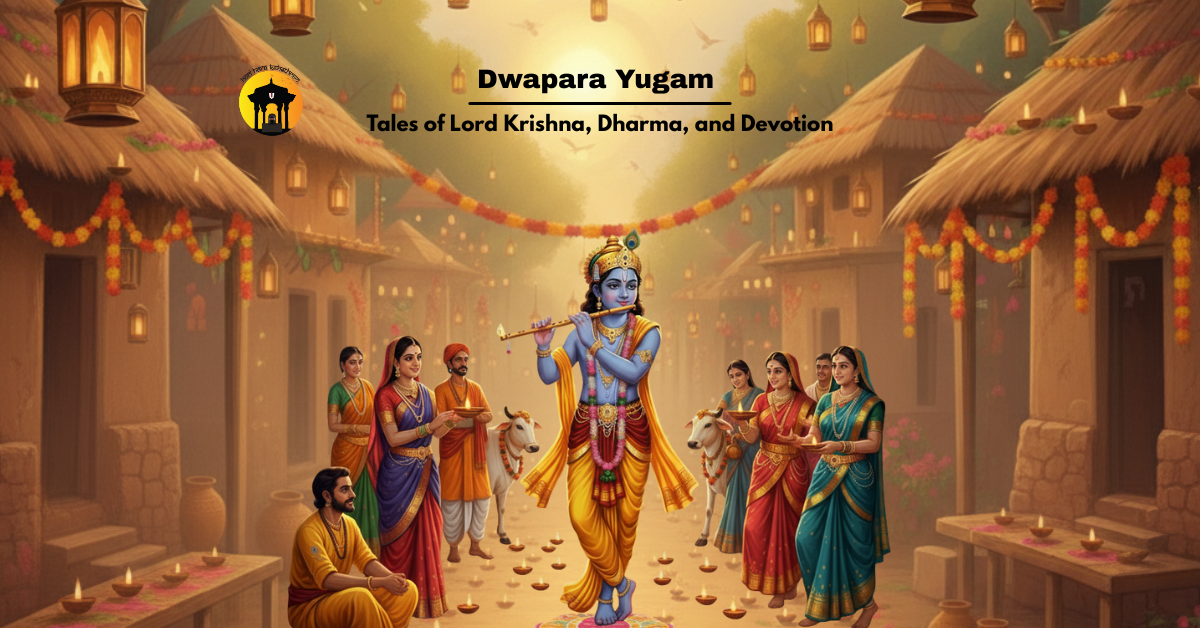
The Dwapara Yugam witnessed the most celebrated divine birth in history — the birth of Lord Krishna. Born to Devaki and Vasudeva in the prison of Mathura, His arrival brought hope to a land ruled by tyranny. His uncle, King Kamsa, feared a prophecy that Devaki’s son would be his destroyer.
To protect the divine child, Vasudeva carried the newborn Krishna across the flooded Yamuna River to Gokul, where He was raised by Nanda and Yashoda.
From His childhood, Krishna’s divine play (leelas) enchanted the world — lifting the Govardhana Hill to protect devotees, dancing on the serpent Kaliya, and spreading love in Vrindavan through His flute and grace.
The Mahabharata – The Eternal Story of Dwapara Yugam
If Tretha Yuga was defined by the Ramayana, then Dwapara Yuga was marked by the Mahabharata — a profound epic of dharma, devotion, and destiny.
The Mahabharata narrates the struggle between two royal families — the Pandavas and Kauravas — symbolizing the eternal conflict between right and wrong.
In the great war of Kurukshetra, Lord Krishna served as Arjuna’s charioteer, revealing the sacred teachings of the Bhagavad Gita.
His message was timeless:
“Perform your duty without attachment to results — act for dharma alone.”
Through these teachings, Krishna reminded humanity that spiritual liberation (moksha) lies in selfless action, devotion, and surrender to the Divine.
Dwapara Yugam and Diwali – The Victory Over Narakasura
One of the most significant events of Dwapara Yuga that connects to Diwali is the defeat of Narakasura, the arrogant demon king who ruled Pragjyotisha.
Narakasura had enslaved celestial beings and stolen divine treasures, spreading fear across worlds. At last, Lord Krishna, along with Satyabhama Devi, destroyed Narakasura on the day before Diwali — known today as Naraka Chaturdashi or Choti Diwali.
As the demon fell, Krishna declared that the day should be celebrated as a festival of light, purity, and renewal. People lit lamps across the land to honor the Lord’s victory and the restoration of peace.
Thus, Dwapara Yugam’s Diwali story teaches that true light is not external — it is the wisdom and purity that triumphs over the darkness within.
The Significance of Dwapara Yuga
The Dwapara Yugam holds immense spiritual significance in Hindu cosmology. It represents the transition from higher consciousness to human struggle, where faith and logic began to balance each other.
Key lessons from Dwapara Yugam include:
- Divine guidance is eternal: The Lord manifests whenever dharma declines.
- Wisdom is light: Knowledge and devotion are the paths to liberation.
- Duty is sacred: Every soul has a divine role in maintaining balance.
- Karma is real: Our thoughts and actions shape our destiny.
In this Yuga, knowledge (jnana) began to rise, preparing humanity for the challenges of the upcoming Kali Yuga.
Spiritual Legacy in Today’s Times
Though the Kali Yuga now prevails, the essence of Dwapara Yugam lives on through the Bhagavad Gita, Krishna temples, and the practice of devotion (bhakti).
At Hari Hara Kshethram Temple in Georgetown, Texas, devotees celebrate the teachings of Lord Krishna through Gita chanting, Krishna Janmashtami celebrations, and Diwali rituals that honor the divine victory of light.
By embracing prayer, humility, and service, we continue the spiritual legacy of Dwapara Yugam — a reminder that divine truth never fades.
FAQs About Dwapara Yugam
1. What is Dwapara Yugam?
Dwapara Yugam is the third of the four Yugas in Hindu cosmology, representing an age where dharma declines to half, and divine wisdom guides humanity through knowledge and devotion.
2. Who was the main deity of Dwapara Yuga?
Lord Krishna, the eighth incarnation of Lord Vishnu, was the divine embodiment of this Yuga. His life and teachings form the foundation of its spiritual essence.
3. What happened during Dwapara Yuga?
This era witnessed the events of the Mahabharata, the revelation of the Bhagavad Gita, and the defeat of the demon Narakasura, symbolizing the victory of light over evil.
4. How is Diwali connected to Dwapara Yuga?
In Dwapara Yuga, Lord Krishna and Satyabhama killed Narakasura before Diwali. People celebrated this victory with lamps, giving rise to Naraka Chaturdashi, a key part of Diwali.
5. What can we learn from Dwapara Yuga today?
The Dwapara Yugam story teaches us to live with devotion, selfless action, and inner wisdom — principles that remain timeless even in the modern world.
Final Thoughts: Keeping the Light of Dwapara Yugam Alive
The Dwapara Yugam is not just an age in time — it’s a mirror of the human journey toward truth. Lord Krishna’s life and teachings continue to guide seekers toward dharma, devotion, and divine understanding.As we celebrate Diwali and remember Krishna’s victory over Narakasura, may we also light the lamp of knowledge within ourselves and spread the wisdom of Dwapara Yugam in our lives.